Professional · Case Study 02
Delivering When It Cannot Wait
Global 24-Hour Design Framework · Wells Fargo
A failing project at the edge of cancellation and a global team stuck in sequence, losing to a deadline. I turned time zones from a coordination problem into a delivery advantage, and recovered it in under 30 days. Turning a near-cancellation into a $2–4M relationship
Client
Wells Fargo
Role
Senior UX Manager
Scope
8 designers (final)
Recovery
Under 30 days
The Situation
A leadership and structure vacuum, not a performance problem.
The team lead was running an agency-style delivery model inside an enterprise environment that demanded the opposite. The team was misaligned, work was behind schedule, and client trust was severely damaged. I was brought in to pivot a project at risk of full cancellation.
A 3 person USA based team had no operational direction and no framework to accelerate recovery.
Cancellation
Active risk to the engagement
Sequential
Work moved one piece at a time
Misaligned
Roles vs. individual strengths
Underused
Global team at single-region pace
Behind
Output trailing schedule
Broken
Client trust at breaking point
The Diagnosis
I slowed down for one week to understand exactly what was broken.
The instinct under pressure is to move faster. I did the opposite. by assessing the team, the work, and the operating model within the first sprint before touching a deliverable. Roles were misaligned to strengths. There were no parallel work streams, the global team was underused, and tooling was throttling speed.
The Core Insight
The Intervention
3 structural moves.
Move 01
Parallel Track Structure
Track 1 · Low-Fidelity
Wireframing and lo-fi design, always running one sprint ahead of production.
Track 2 · High-Fidelity
Hi-fi design, content, and prototyping — building on validated lo-fi output.
Move 02
Strategic Role Realignment
I assessed individual strengths and restructured accordingly with full autonomy from leadership, used decisively.
- Moved a detail-oriented senior designer, stronger in requirements than client-facing work, to lead Track 1
- Hired a client-facing lead with sharper stakeholder communication
- Onboarded three additional designers in APAC to support 24-hour coverage, drawing on a pre-vetted bench
- Every person ended up in the role that matched their actual strength
Move 03
Global 24-Hour Delivery Framework
A follow-the-sun handoff across three regions. Each regional lead ran a structured end-of-shift standup which included requirements, work completed, confirmed tasks for the incoming region, and open questions. Content and research were built into the handoff. Design work ran 24 hours; the clock never stopped.
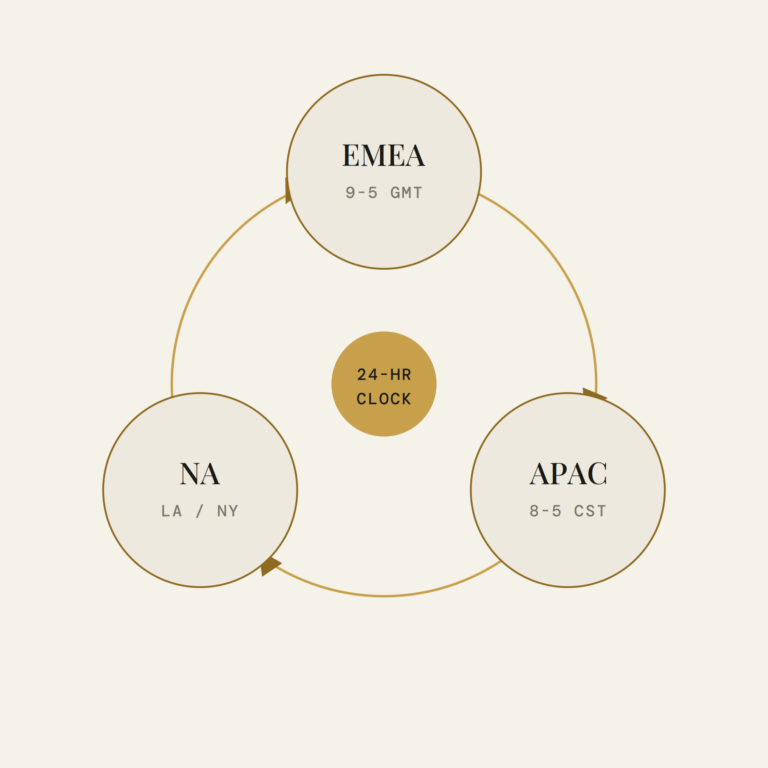
EMEA → NA
Handoff at 5pm GMT / 12pm EST
NA → APAC
Handoff at 4pm PST
APAC → EMEA
Handoff at 5pm CST / 9am GMT
Every handoff
Structured end-of-shift standup including requirements, completed work, next tasks, open questions.
The Result
A project at the edge became a relationship.
baseline → +30–40%
at risk → <30 days
8-hour → 24-hour
0→ +2
cancellation→ $2–4M
Leadership in Action
Structure and urgency, at the same time.
Diagnosed before touching the work.
Under pressure I slowed down for one week to understand exactly what was broken, then moved with precision.
Restructured on strength, not seniority.
The right people in the right roles wasn't a negotiation. It was a requirement for recovery.
Turned geography into an asset.
Most teams treat time zones as a coordination problem. A global team running 24 hours is faster than any single-region team running 8.