Case Study 04
Military Customer Verification Redesign
Consumer Product Craft · Lowe's
A verification flow that made loyal customers give up partway through. The fix wasn’t a new interface; it was one reordered step that protected revenue, lifted conversion, and turned a discount into a loyalty event.
57%
Faster task completion
91%
Verified completion rate
19pt
Drop-off reduction
4.7/5
User satisfaction
Organization
Lowe's Companies, Inc.
Fortune 50 Retail
Role
Senior UX Manager
Team
1 designer · 1 researcher
Timeline
3 sprints
The Business Problem
A design symptom on top of a business architecture flaw.
The initiative addressed a broken enterprise flow that was costing Lowe’s on three dimensions simultaneously:
- Verification spend on user who never converted
- Loyalty enrollment delay for a high-valued customer segment
- Digital experience out of step with modern standards.
The existing flow had a structural flaw: It required ID.me verification before account creation. That sequencing decision had downstream consequences across cost, conversion, and customer loyalty. This was not a design problem. It was a business architecture problem with a design symptom.
The Diagnosis
The business case was formed without UX in the room.
The Decision
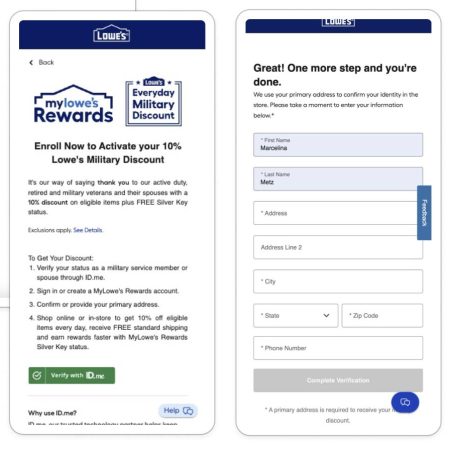
Before: Verify Identity → Create Account → Access Discount. Cost incurred before account creation, including for users who abandoned.
After: Create Account → Verify Identity → Discount + Loyalty. Verification cost gated to confirmed account holders. Loyalty captured up front.
The Intervention
2 structural moves.
Framework
A seven-phase delivery framework, introduced before design began
I established the operating structure first. Each phase had defined entry criteria, artifact outputs, and a handoff condition. No work entered development until it passed validation and the framework became the team’s repeatable standard going forward.
- 01 · Strategy & Intake: Aligned with Product on business objectives, user needs, and problem scope before any work begin
- 02 · Pre-Discovery: Reviewed existing analytics, prior research, and constraints. Success criteria defined before discovery opened.
- 03 · Discovery: Product is included during a structured research phase with defined artifact outputs. User needs and requirements gaps surfaced before ideation.
- 04 · IA & Wireframing: Translated research outputs into information architecture, user flows, and wireframes. Structure established before visual design began.
- 05 · Visual + Content: High fidelity execution aligned to brand standards. Content Strategy integrated into design.
- 06 · User Testing: Validated with real users via Scout. Feedback loop closed before build
- 07 · Ready for Dev: Designs validated, requirements, and package delivered to engineering. No build begins without validation evidence.
Decisions
Three decisions shaped the outcome
I established the operating structure first. Each phase had defined entry criteria, artifact outputs, and a handoff condition. No work entered development until it passed validation and the framework became the team’s repeatable standard going forward.
- 01 · Reframe the problem: Moved the work from “UI refresh” to business architecture; the sequencing was the issue, not the styling.
- 02 · Find the retention opportunity: Members who abandoned before account creation were never enrolled. I connected the redesign to loyalty acquisition, expanding the business case beyond cost.
- 03 · Structure delivery before execution: Research methodology and success metrics were defined before a single screen was designed.
The Result
Every metric traces to a decision made before design began.
72% → 91%
6m 45s → 3m 10s
28% → 9%
3.2 → 4.7
Source: user validation with military-affiliated participants · old flow vs. new flow
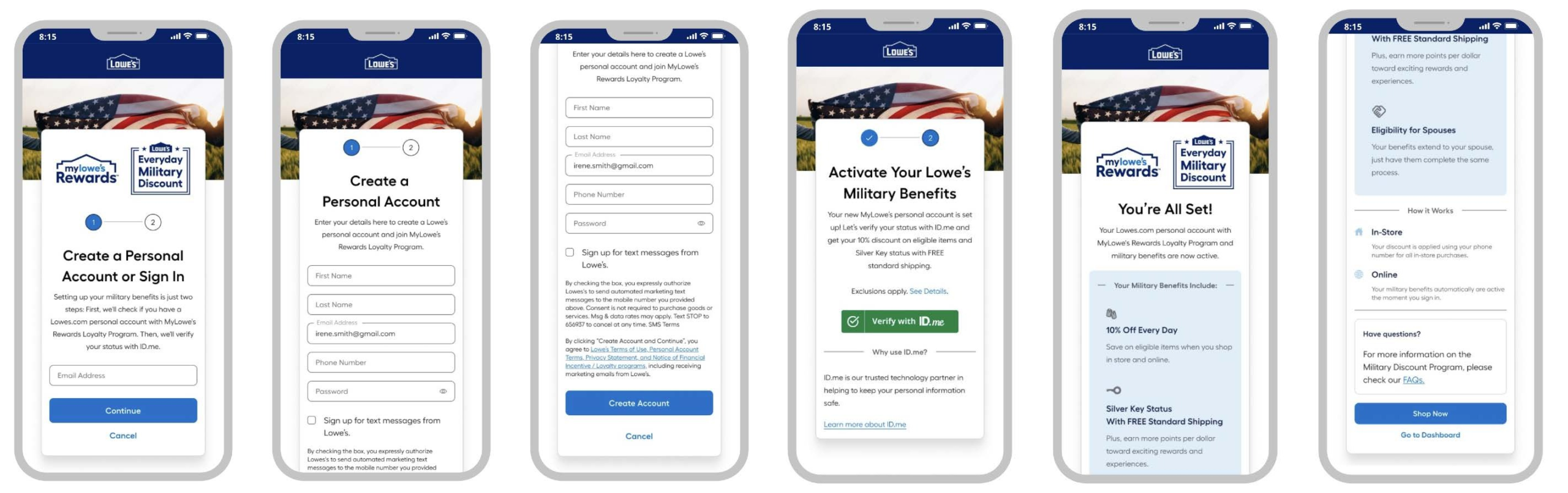
Three fronts, one reordered step.
Retention
A discount transaction became a loyalty acquisition event, ie members enroll earlier, before verification completes.
Conversion
Completion up 19 points; drop-off cut from 28% to 9% by removing the primary abandonment point.
Cost
Unqualified verification spend eliminated. Lowe's stopped paying for users who would never onboard.
Leadership in Action
Craft and strategic influence, in the same project.
Upstream business influence.
UX entered at the strategic layer before the business case was finalized. The loyalty opportunity was surfaced before a single screen existed.
Delivery structure as a business decision.
The seven-phase framework was introduced, applied, and institutionalized. Governance was the mechanism that converted a tactical request into a measurable outcome.
Consumer craft at scale.
The redesigned flow was validated with real users and landed a 4.7/5 satisfaction score. The outcome took both structural governance and screen-level product judgment.